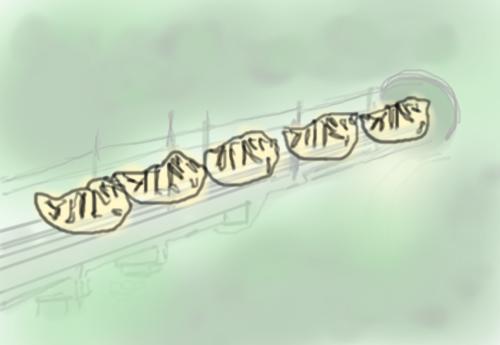
Um...it was kind of foggy when this picture was taken. Yeah...
We had some friends over for Thanksgiving dinner and we ended up talking about various things, but the most memorable topic was Taiwan‘s most advanced public transportation system, the high speed potstickers (鍋貼 or guō tiē), which is not to be confused with the high speed rail system (高鐵 or gāo tiě).
Many people know about Taiwan’s high speed rail (HSR) system. The HSR runs north and south along the coast from the capital city of Taipei to Kaohsiung, a distance of roughly 200 miles. The trains have a top speed of 186 miles per hour, so travel by HSR is considerably faster than by normal rail or bus, but slower than taking a plane. You can read more about it here.
The high speed potstickers (HSP) is an auxiliary system that runs east and west and is little known beyond the residents of Taiwan. Actually, the HSP is such a well kept secret, many residents also do not know of its existence and slog along by bus when they need to travel from the east and west coasts. It is understandable since the HSP travels considerably faster than the HSR and is much quieter. Because the railcars are made of potstickers, albeit a special recipe for potstickers due to the need for durability, they can be consumed at the end of their scheduled run. I’m pretty sure employees of the HSP eat the potstickers.
Aside from the very limited schedule, there are a few other cons to traveling by potsticker. You have to remember that these are potstickers. They are cooked in oil. There can be a great deal of oil in and around the stations and on the potstickers themselves. Oil is not something that is easily cleaned off clothing when you’re on the run.
Also, the friction of the potstickers traveling at high speed on the oil coated rails, so they don’t stick, cook the potstickers. If you’re riding a late potsticker, it can be unbearably hot. It will smell delicious though. But remember, it’s highly frowned upon to sneak bites of your transportation.
On the topic of scents, some of the potstickers may have a pork/leek filling. While quite delicious, leek does have a tendency to stink things up. You might want to take that into consideration when you’re traveling to a formal engagement. Durian are allowed on the pork/leek potstickers, though, in case you’re transporting durian.
I’m definitely going to try and find a high speed potsticker station the next time I’m in Taiwan.
 Random moosages as I see fit.